

Based on the following criteria, you’ll be able to decide which handpan is the best for you. There’s no universally applicable wisdom on what the best handpan is, as it depends on many factors. The only requirement is that the chosen instrument meets the minimum expected quality, meaning it should sound beautiful and not be out of tune.
Let’s explore how to make your choice and what quality you can expect at different price points!
When choosing a handpan, the most important considerations are as follows:
You can read about these considerations in detail below!

The first handpans were priced between approximately 2,000 and 9,000 euros. Fortunately, today you can purchase a quality instrument for considerably less.
Nowadays, you can buy a mass-produced handpan for as little as 200 euros, while more expensive (and sophisticated) instruments can cost up to 5,000 euros or more. Prices and quality vary widely between these extremes, so it’s important to know what you’re getting for your money and what is ultimately worth purchasing.
The price of a handpan is influenced not only by quality but also by the number of notes. Handpans with more notes, or those with additional notes on the bottom, are more expensive.
Ultimately, your budget will decide the maximum amount you can spend on a handpan.
So let’s clarify what these prices actually mean!
It’s possible to say under what price purchasing a handpan is practically a waste of money.
As of now (2025), for instruments still considered to be of good quality, this is around 700 euros.
It’s not recommended to buy for less than this, as it’s nearly impossible to produce an instrument from durable materials, with skilled craftsmanship and proper tuning (i.e., not out of tune) for less. These are the instruments you can enjoy playing for many years.
Handpans priced between 100-200 euros are typically of very poor quality, don’t sound clear, and are out of tune (which mostly cannot be fixed). So, there’s a high chance they’ll end up forgotten in a closet.
Generally, based on quality grading, you can choose from the following price categories:
If you’re planning for the long term, opt for the highest price category you can afford.
If the manufacturer is reliable, then a more expensive handpan is guaranteed to be a better choice than a cheaper one.
The exact price depends on the brand, model, and place of purchase.
Avoid ordering dirt-cheap Chinese products.
If it looks too cheap and too good in photos, it probably won’t deliver the experience you expect, and you’ll likely be disappointed.
While handpans from sites like Temu or Alibaba may seem nearly free, their biggest danger is that they can discourage an enthusiastic beginner.
As a beginner, it’s even harder to determine whether you’re playing the handpan incorrectly or if the instrument itself is limited. With inexpensive handpans, it is almost certain that the issue lies with the instrument, and even an advanced player wouldn’t be able to produce a beautiful sound with it.
Ultimately, you’ll need to decide what you can afford, but we recommend thinking long-term.
Purchasing a handpan is an investment, one you may truly appreciate 1-2 years from now when you become a confident handpan player.
It’s much better to obtain a handpan with clear sound initially, rather than buying a second handpan two years later. You’ll be grateful to yourself for purchasing at least an entry-level or medium-quality handpan.

If your budget is below 700 euros, consider renting, buying used, or opting for a tongue drum instead. The sound of a tongue drum is quite similar to a handpan, and about 70-80% of the playing technique is the same. However, tongue drums have a much more favorable entry price than handpans.
The scale to which a handpan is tuned determines its sound and mood, as well as the types of songs you can play on it.
The scale can be major, minor, or a mix of both.
The right scale for you depends on your skill level and what you aim to achieve with the instrument.
There are currently nearly 200 different scales, which can be overwhelming, especially for beginners. Thus, we’ll name a few specific scales suited for both beginners and advanced players below.
A general recommendation for a first instrument is always the D Kurd scale because it offers flexibility.
Most instructional videos are also based on this scale, and you can play almost any song with it.
This scale is suitable even at a higher level and if you wish to jam with others later on.
| Complete beginner | Intermediate, advanced | Advanced musician |
| you’ve never played an instrument before and don’t know how to read sheet music.you played an instrument a long time ago.you know how to play scales or simple songs | You can play more complex songs and perform at an advanced level. | You’re a musician who plays an entirely different instrument, but you have never played the handpan before. |
| D Kurd 10 | D Kurd 18-20 | Full scale with 17-20 notes: examples include C# Annaziska, F# Kurd, and C Ashakiran. |
The first handpans had “only” 7-8 notes, but nowadays, handpans can be crafted with more than 20 note fields.
For beginners: 8-10 notes are sufficient.
If planning long-term: request as many additional notes as your budget allows, as they will be useful later.
Or, what to watch for if your musical knowledge is limited or basic.
The most important aspect is that the notes are clearly tuned, at least as well as you can judge as a beginner.
Fortunately, beginner players can usually hear the differences in quality.
If you’re unsure, ask the seller for a tuner, which will objectively show if the note matches the one indicated on the note field.
You can also use a tuner app if the store is quiet enough (apps unfortunately don’t work well with background noise, so a device is preferable).
If the handpan is out of tune, the notes will clash, which will be jarring to your ears, and you’re likely to notice.
Pay attention to the playing experience, specifically if there are any notably dull or sharp tones, which are not good signs.
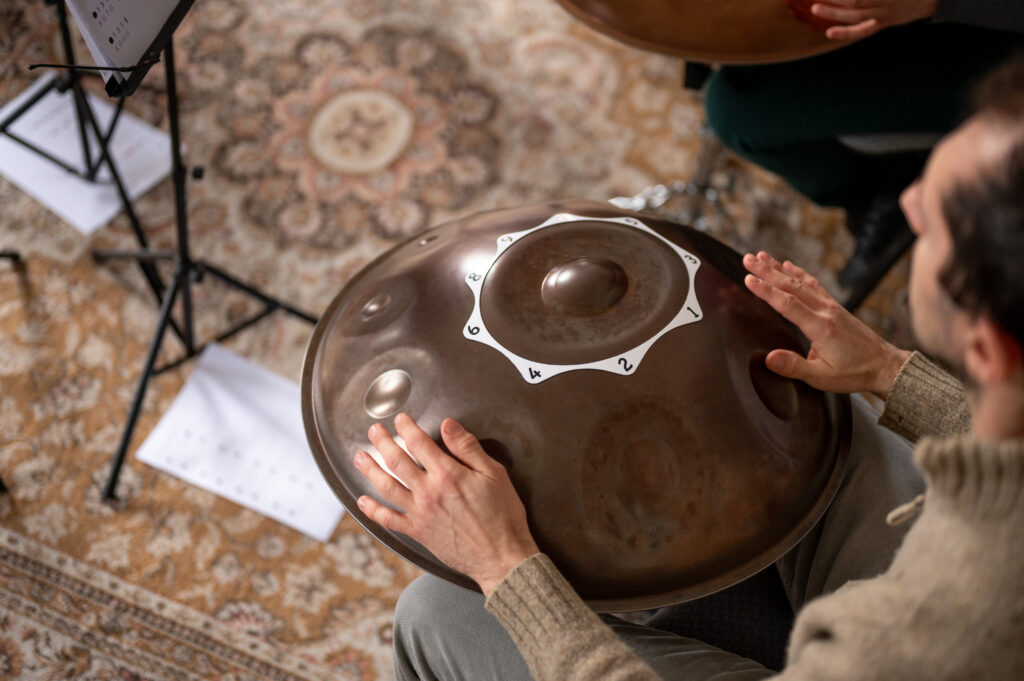
A handpan with many notes and complexity is a good choice to accompany yourself. Ensure it includes both low and high notes.
Mixed scales (major and minor), and those with a variety of high and low notes, often give the handpan an exotic soundscape.
For example:
The type of music you want to play will affect your handpan choice.
For classical music, you’ll need several handpans since they are not chromatic instruments; therefore, at least 2-3 handpans are necessary..
Well-known modern melodies and film scores can be played with just one handpan with lower notes and a full scale.
In such cases, D Kurd is not the most ideal choice; instead, opt for C# Annaziska, E Kurd, or F# Kurd.
The best option is a physical store, ideally a specialty shop, where experts can offer advice and retune your handpan if needed.
You can also order online from a website specialized in handpans, but ensure that the manufacturer/seller is reputable, with good references.
Feel free to order from the MAG webshop or visit our store in the 11th district. You’ll receive comprehensive support from us, and our handcrafted handpans are recognized on international forums. For instance, the renowned UK-based Master the handpan music school mentions our manufactory as a recommended place to purchase handpans.
Purchasing from large general platforms or big music stores is not recommended, as they typically do not have knowledgeable staff, and they sell instruments of mediocre quality.
Avoid buying from the previously mentioned Chinese webshops (Temu, Alibaba).
Listen to different scales on YouTube, explore handpan music, read about various brands and manufacturers, and, if possible, seek advice from musicians or music teachers. Since a handpan is a significant investment, take your time to ensure you choose the best handpan for you!
If you need advice or have questions, feel free to contact us—we’re happy to help you choose a handpan!
maghandpan@gmail.com!
