

How to play the handpan (well) as a beginner? In this article, you’ll learn 4 essential striking techniques, complete with clear and precise instructions.
Additionally, we’ll provide practical tips to make your learning and practice sessions even more effective. Follow these tips, and you too can enjoy creating beautiful music on the handpan!
If you don’t (yet) know how to play the handpan, the first step is to get to know the instrument!
To fully understand the technical explanations, you need to familiarize yourself with the terminology and the names of the handpan’s components.
Before you start learning to play the handpan, begin from scratch and take some time to familiarize yourself with the instrument.
Of course, it’s hard to resist the temptation to immediately try out your new handpan and hear its beautiful sound. Once you’ve basked in that initial euphoria and enjoyed the delightful resonance of every strike, take a moment to set it aside for a little while.
Take a close look at your handpan, study it, and learn the names and functions of its parts. Locate the notes and familiarize yourself with their placement.
You can position yourself in two main ways:
The most important thing is that your position feels comfortable!
Keep your torso straight, and relax your shoulders.
Lean your back against something for support.
Warming up your hands and fingers helps you avoid injuries and discomfort while playing. Spend a few minutes stretching and moving your fingers and wrists in circular motions. Open your palms wide, then close them into a fist. Interlock your fingers and gently rotate your wrists together.
Long nails can interfere with your playing, and jewelry can damage the surface of the handpan. Therefore, keep your nails short and remove any jewelry (rings, bracelets) or watches from your hands. Long necklaces can also get in the way, so avoid wearing those as well while playing.
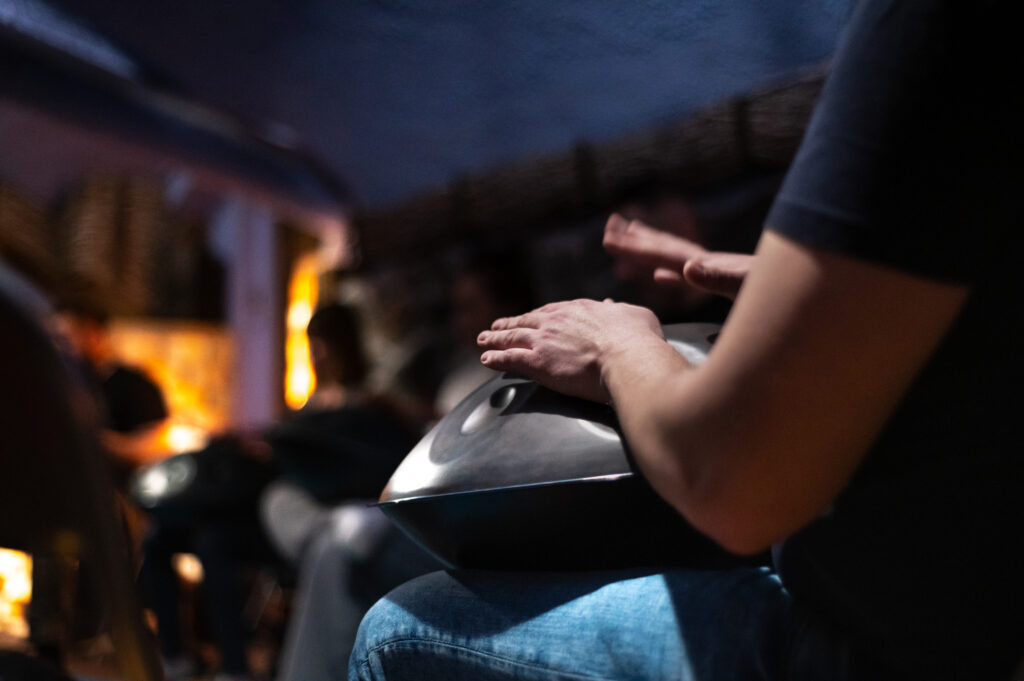
The way you strike the handpan determines whether it resonates cleanly and beautifully. That’s why it’s crucial to start your learning journey by understanding the theory behind the techniques and diligently practicing how to perform them correctly.
Practice one technique at a time until you can play it confidently.
Resist the temptation to jump straight into playing scales or songs at the very beginning of your learning process. Enthusiasm is great, but diving in recklessly without dedicating time to perfecting the right movements will result in unclear and inconsistent notes.
Did you know that by playing the same melody with different rhythms, it can transform into two entirely different songs, making it almost unrecognizable that they share the same origin? Don’t believe it? Try it yourself! While this may fall under music theory, rhythm is such a fundamental aspect of music that understanding it is an absolute must.
Once you’ve nailed your finger techniques and the tone fields produce a clear sound, play each note on the handpan. Explore the range of tones and ensure you can strike each note with clarity and precision.
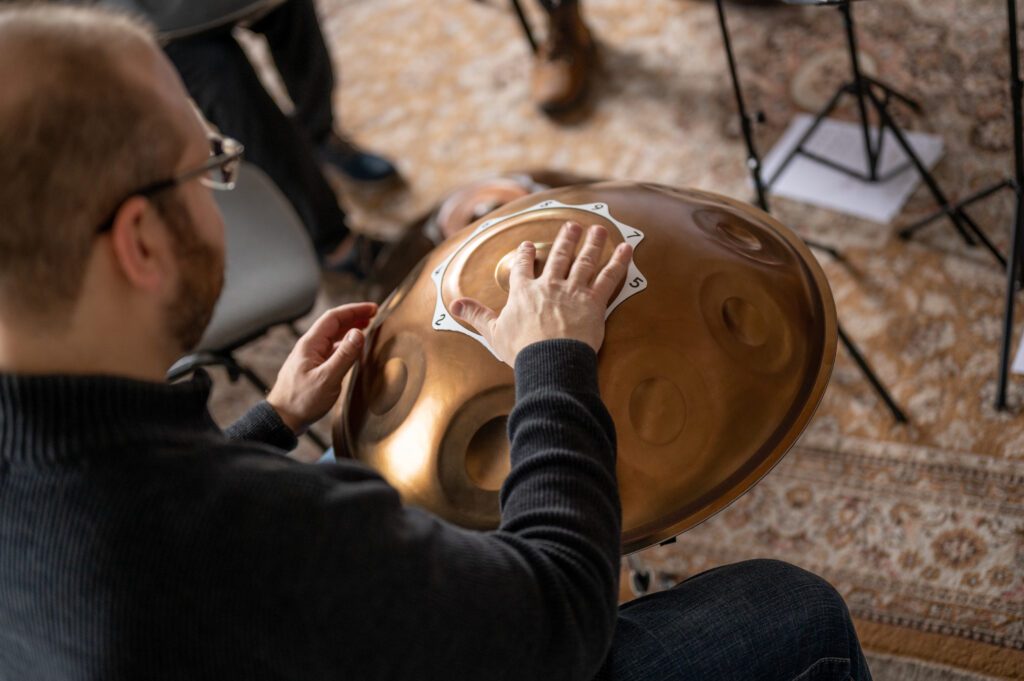
It’s not just how you practice that matters—your habits and routines play a crucial role in your progress. These habits will help you master the handpan in a way that others will truly enjoy listening to.
Consistency is key when learning any musical instrument. It’s better to practice more frequently for shorter periods than to play for hours at a time but sporadically. Regular practice is something that cannot be replaced.
If you play only occasionally (once or twice a week), the correct techniques won’t stick, and you’ll find yourself starting over repeatedly. The best approach is to practice daily—even small, steady progress each day ensures continuous growth and improvement.
Set a fixed time for your practice sessions. By dedicating a specific time, you can easily build it into your routine and integrate it into your daily life.
Listen to handpan music as often as you can, but don’t just let it play in the background—pay close attention to it. Actively listening will help you better understand the music, rhythm, and melodies, deepening your connection to the instrument.
MAG x HUG / Samantha Archer / F#2 Minor 16
Be patient with yourself and don’t expect too much in the beginning! Don’t aim to play like a master right away. While the handpan is relatively easy to learn and you’ll likely experience success during your first practice sessions, it’s important to set realistic expectations—don’t expect miracles overnight. Like anything else, mastering the handpan takes time and dedication.
The first strike
After warming up and settling into a comfortable position, it’s time to strike your first note on the handpan. You can start with any tone field or even the Ding.
Strike along the edge of the tone field at the point where it meets the dimple.
Begin by learning the most fundamental handpan playing technique: the strike technique.
Start practicing using your index finger and thumb.
How To Play Handpan | The FULL Beginner Guide
Practice with both hands, regardless of whether you are right- or left-handed. Feel free to use all your fingers. In fact, it’s beneficial to practice with multiple fingers.
Instead of striking parallel to the floor, follow the curved surface of the handpan, as if you were a fortune-teller gazing into their crystal ball.
Once you can produce a clear, beautiful sound with the strike technique, play through all the tone fields on the handpan.
Experiment with striking other parts of the handpan, including the shell. You’ll immediately notice the difference in sound, which will help you identify if you’re hitting the wrong spot and why the tone isn’t clear.
Choose an easy beginner scale to start with, such as C major or D minor. Gently strike each note in the scale. Pay attention to the vibration of the sound. Play the scale upward and downward, practicing as much as possible. Start at a slow tempo and focus on keeping a steady rhythm. Once you feel confident, gradually increase your speed.
Once you’ve mastered the scale, start experimenting with creating beautiful melodies of your own—it’s so much fun! Gently and slowly strike the notes, and find combinations that sound pleasing to your ears. You can adjust the speed (tempo) by playing slower or faster.
Try some basic rhythms, such as a steady pulse or simple subdivisions. Let your creativity guide you!
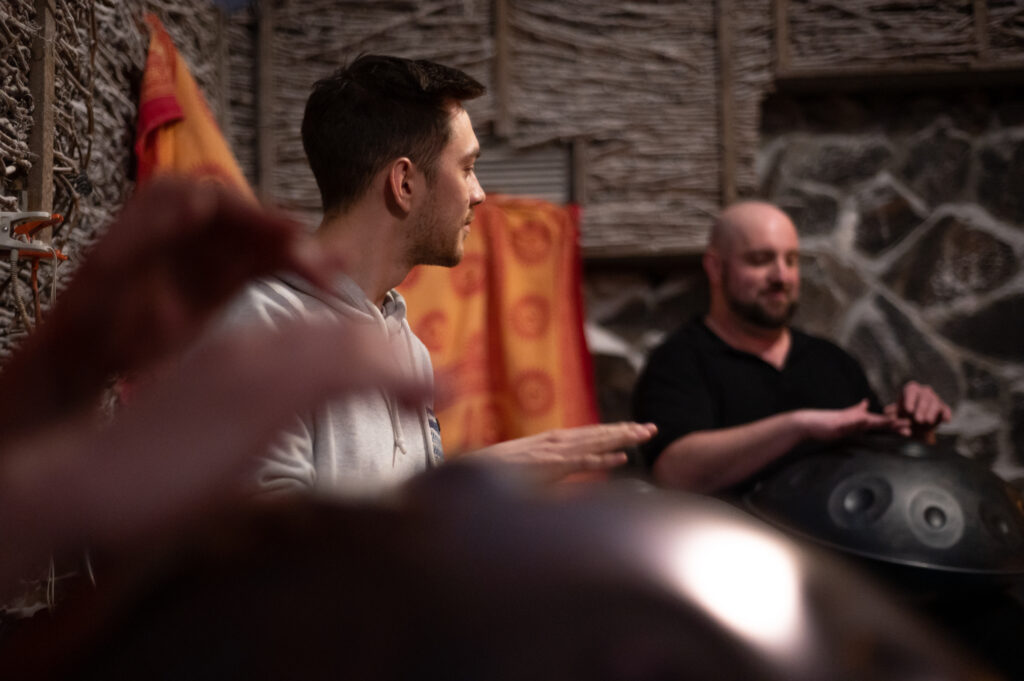
1. Strike technique:
The most fundamental playing technique for the handpan. This involves striking the tone fields with your fingers or palm using a quick, decisive motion. Your finger or hand must bounce off the surface quickly, as if the instrument is burning your skin—otherwise, the sound won’t resonate crystal clear.
2. Dampening technique:
Dampening involves softening or muting the sound. After striking the tone field, lightly place your finger or palm on the note. This motion stops the vibration and causes the sound to fade. The key here is to find the right balance between a strong strike and complete muting. Experiment with varying levels of pressure to discover how to maintain sound clarity while softening it just enough.
3. Slap technique:
Strike the tone field with your fingers or palm in a way similar to how you might play other percussive instruments. This creates a sharp, distinctive sound. This technique can add variety and dynamics to your playing, enhancing the rhythmic, percussion-like energy in your performance.
4. Harmonic technique:
Gently touch the note at specific harmonic nodal points while it vibrates. This produces a sound similar to a bell chime. This technique enriches and adds color to your playing, creating an ethereal quality within the music. It’s often used in slower compositions. Incorporating this technique expands your tonal palette and makes your music more expressive.
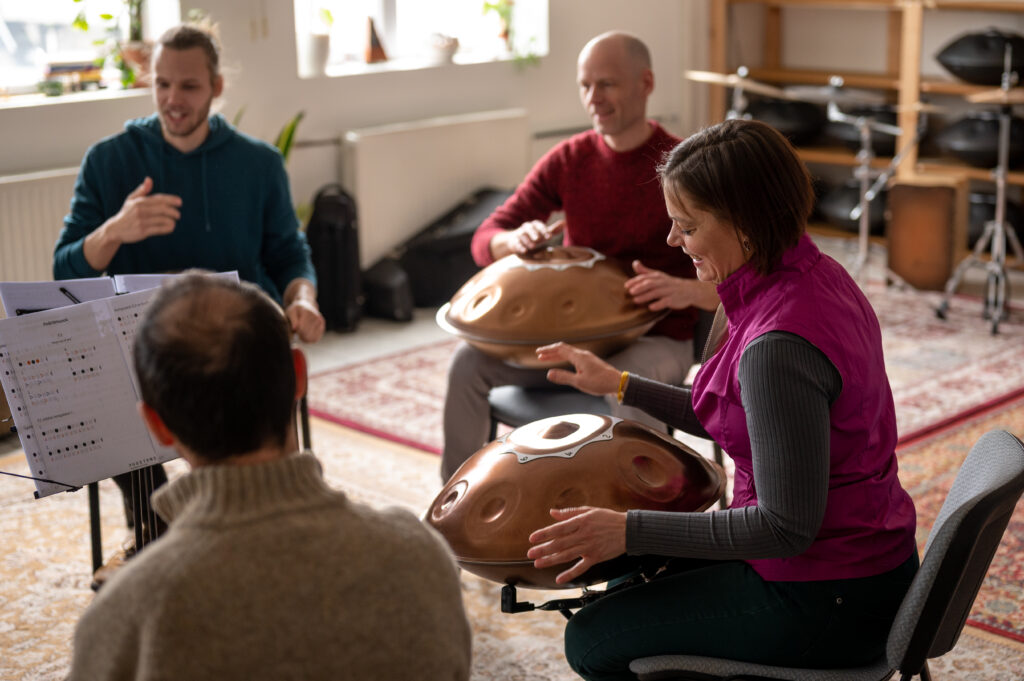
Strike the handpan with different intensities: Experiment with softer and stronger strikes, then combine the two. Observe how the change in intensity alters the instrument’s tone and texture.
Play on the rim: Try striking the rim of the handpan. The sound will be much softer and more subtle, offering a different tonal quality to explore.
Alternate your hands: Practice switching between your hands quickly to make your playing more energetic and dynamic. Start by alternating right and left hands for consecutive strikes. Take your time—your hands might feel out of sync, or you could get confused at first, but don’t rush. Start very slowly and focus on maintaining rhythm. If your playing is steady, you’re doing it correctly. Once you feel confident, gradually increase the tempo, but only step up the speed slightly at a time.
Add emotional depth with energy and dynamics: Strike the handpan with varying levels of intensity, and notice how the sound changes. Try gradually increasing and decreasing the force of your strikes, and observe how the dynamics shift. Use your shoulders to add more power. Think of it like playing a piano piece—for example, Beethoven’s music is famous for its dramatic dynamics, where the player adjusts the intensity of striking the keys so the melody grows louder or softer. This creates emotional depth and makes the music come alive. The same principle applies to any instrument, including the handpan. Experiment with these variations to breathe life into your music.
Mátyás Székely I Compositions on an E Amara 20 MAG handpan
Selecting a high-quality, well-tuned handpan is key to keeping your enthusiasm and motivation alive during practice. Even as a beginner, it’s not recommended to buy a cheap, low-quality Chinese handpan, as they tend to sound out of tune, are unenjoyable to play, and cannot be properly re-tuned. Instead, consider affordable entry-level handpans, rent one, or look for a good-quality used instrument.
It’s also crucial to choose a handpan scale suitable for beginners. The C major scale is often recommended as it’s easy to play and sounds pleasant.
Once you’ve chosen your instrument, make sure to protect it from the elements. Keep it in its case, clean it with a microfiber cloth to remove dust, and apply a thin layer of oil every few weeks to maintain its surface.
By following these simple care steps, your handpan will last for many years and continue to sound beautiful every time you play.
If you remember just one thing, let it be this: with regular practice, perseverance, and a genuine love for the handpan, success is 100% guaranteed. The timing? That’s entirely up to you.
Wishing you patience, progress, and joyful handpan music-making!
